
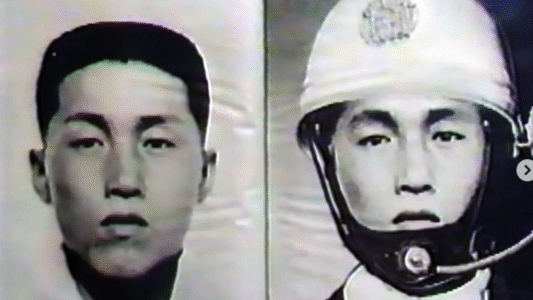
December 10, 1968 –In a crime that continues to fascinate and perplex, a seemingly audacious, yet meticulously planned, robbery unfolded on the streets of Tokyo, netting an astounding 300 million yen (approximately $2.5 million USD at the time) and leaving authorities scrambling for answers. The perpetrator, a man posing as a police officer, vanished without a trace, making this one of Japan’s most infamous unsolved heists.
The day began like any other for the employees of the Nihon Shintaku Ginko (Japan Trust Bank). A nondescript cash transport vehicle, an armored car carrying a staggering 300 million yen in bonus payments for Toshiba employees, was making its rounds. The route was routine, the security measures standard, and the cargo, while substantial, was a common occurrence for a major bank.
However, the routine was about to be shattered by a truly extraordinary act of deception. As the armored car navigated a quiet stretch of road, it was flagged down by a motorcycle police officer.
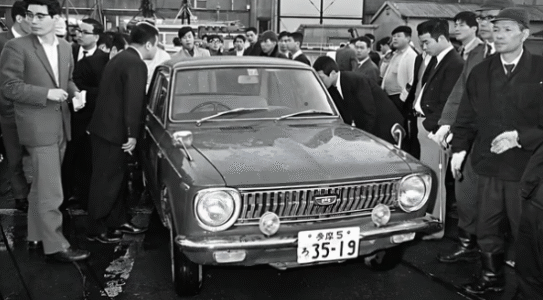
(The car used for the 300 Million Yen Robbery.)
The urgency and gravity in his voice, coupled with the convincing uniform and official-looking motorcycle, immediately put the bank employees on edge. The “officer” then ordered them to exit the vehicle, claiming he needed to investigate a potential explosive device under the car. He even simulated looking under the vehicle, further adding to the illusion. The visible smoke, which the impostor had cunningly pre-planted using a simple flare or smoke canister, gave instant, terrifying credence to his warning.
In a moment of terror and confusion, the bank employees, fearing for their lives, complied. They fled the scene, leaving the “officer” alone with the armored car and its precious cargo. It was only after they had put a significant distance between themselves and the vehicle that they realized the chilling truth: there was no bomb, and the “police officer” was a masterful imposter.
By the time the genuine authorities were alerted and arrived at the scene, the impostor and the armored car had vanished. A massive manhunt was launched, involving thousands of police officers across Tokyo and beyond. Every detail was scrutinized, every lead pursued. The fake police uniform, the police motorcycle – all were carefully crafted elements of the deception. The perpetrator had even used a genuine police-issue helmet and a replica Honda CBX400F motorcycle, indistinguishable from those used by the actual police force.
Investigators quickly pieced together the sequence of events, marveling at the audacity and precision of the crime. The thief had clearly conducted extensive reconnaissance, understanding the bank’s procedures and selecting a secluded stretch of road for the execution of his plan. The psychological manipulation employed – preying on the employees’ fear for their lives – was a key factor in his success.
Despite the monumental effort, the trail went cold. The 300 million yen, primarily in unmarked bills, disappeared without a trace. The identity of the “motorcycle cop” remains one of Japan’s most enduring mysteries. Theories abound, ranging from a lone wolf with a genius for crime to a highly organized syndicate. Some speculate the perpetrator might have had insider knowledge, while others believe it was simply an incredibly well-executed, opportunistic crime.
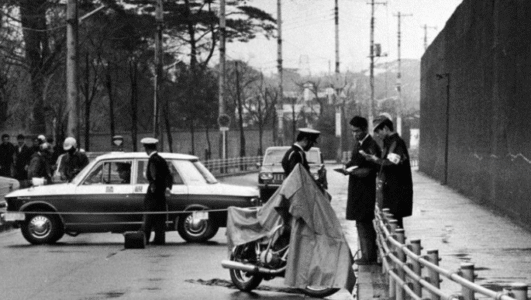
The civil statute of limitations officially expired in 1988, meaning the man who executed one of the most audacious heists in history can now walk free without fear of criminal legal reprisal.
Fourty-five years later, the legend of the phantom motorcycle cop and the 300 million yen continues to captivate the public imagination. The case remains officially unsolved, a testament to the ingenuity of a criminal who, for one dazzling moment in December 1968, managed to outwit an entire system and disappear into the annals of criminal history.